

Last December, a pitmaster named Elias discovered that just 12 days of heavy, wet accumulation had etched permanent cosmetic pitting into his $4,800 stainless steel range. It's a heartbreaking sight for any artisan who treats their fire-box with the same reverence as a hand-forged blade. Learning exactly how to prevent grill rust snow damage is the only way to ensure the harsh elements don't reclaim your investment before the first spring thaw.
You've likely felt that familiar dread when peeling back a heavy vinyl cover only to find trapped moisture blooming into grey mold or a frozen valve that refuses to budge. We understand your grill isn't just an appliance; it's an elemental tool for the rugged gourmet. This guide will help you master the art of preserving your luxury grill against the winter's bite with professional-grade sealing and storage techniques. We'll walk through the specific high-heat oils that act as a barrier against 100% of moisture and the 4-step ritual that keeps your igniters fluid even when the mercury drops below zero.
Key Takeaways
- Understand the elemental chemistry of oxidation and why winter moisture targets the most vulnerable, unseen components of your steel.
- Master the "Seal and Shield" ritual to prevent grill rust snow by purging moisture-trapping carbon and tempering the grates with protective oils.
- Expose the myth of the waterproof tarp and learn how to provide the ventilation necessary to avoid a greenhouse effect that breeds corrosion.
- Navigate the rigors of year-round cooking with professional protocols for clearing heavy snow and managing the thermal shock of the flame.
- Identify the engineering standards of elite brands like Fire Magic and ZLINE that are forged to withstand the harshest alpine environments.
The Alchemy of Oxidation: Why Snow is the Grill's Greatest Adversary
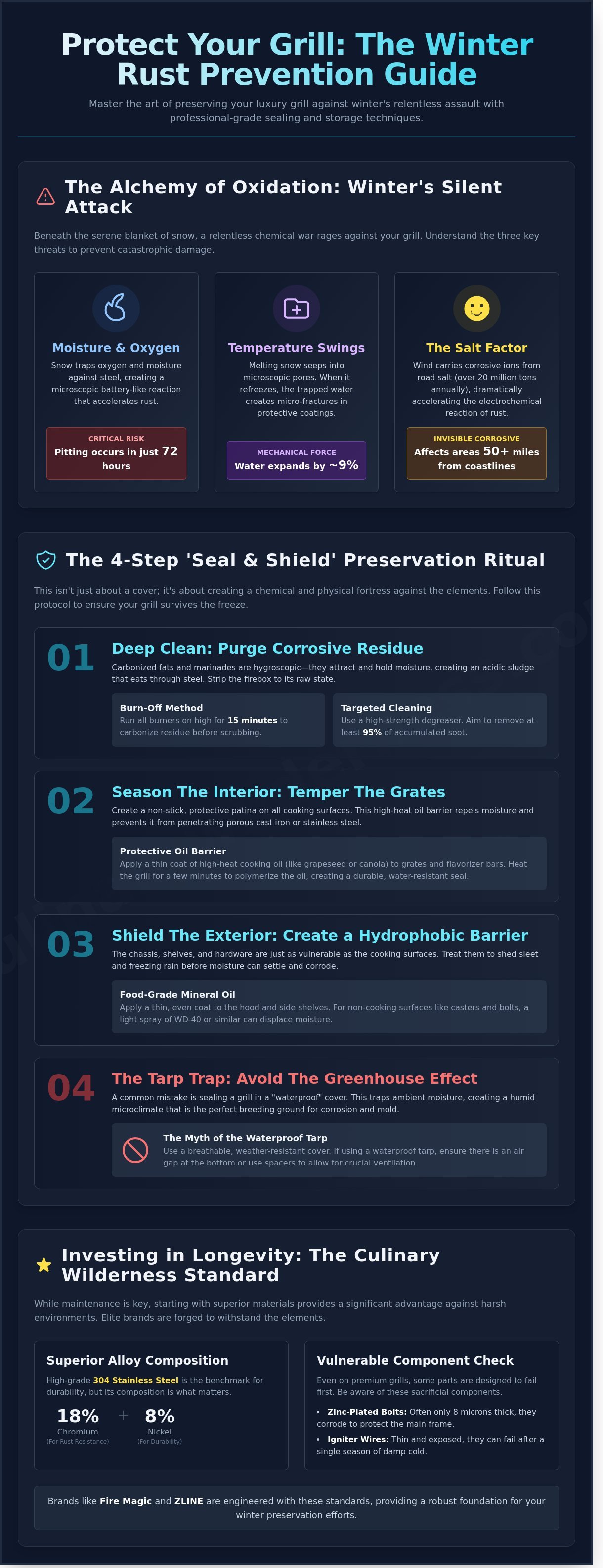
The winter silence in the high country is deceptive. Beneath the blanket of white, a relentless chemical war rages against your outdoor hearth. Iron, oxygen, and moisture converge to dismantle the steel you rely on for open-fire mastery. This process, known as The Alchemy of Oxidation, transforms solid metal into a brittle, reddish dust that flakes away like charred bark. While the exterior of a modern grill might look impervious, the internal components remain deeply vulnerable. Zinc-plated bolts, often measuring a mere 8 microns in thickness, serve as sacrificial lambs to the elements. Igniter wires, no thicker than a strand of wild twine, can fail after a single season of exposure to the damp cold. Even high-grade 304 stainless steel, prized for its 18 percent chromium and 8 percent nickel content, faces limits. By 2026, environmental pollutants like sulfur dioxide and acidic snowfall have made even these premium alloys susceptible to surface staining. To truly prevent grill rust snow must be viewed as a slow-moving solvent rather than just frozen water.
The elemental struggle involves more than just moisture. When snow sits on a metal surface, it traps oxygen against the steel while providing the necessary electrolyte for ions to move. This creates a battery-like reaction on a microscopic scale. In 2025, researchers noted that localized pitting can occur in as little as 72 hours under heavy, wet snow. If you leave your cooking grates or flavorizer bars exposed, the porous nature of seasoned cast iron acts as a sponge, pulling moisture deep into the metal where it begins the quiet work of decay.
Temperature Swings and the Condensation Cycle
When the mercury climbs above 32 degrees Fahrenheit, snow melts and seeps into the microscopic pores of the metal. As night falls and the temperature drops, this water expands by approximately 9 percent. This mechanical force creates tiny fractures in protective porcelain coatings or paint. Within the firebox, a phenomenon known as grill sweat occurs. This internal condensation is often more destructive than external moisture because it sits trapped against unpainted cast iron or thin heat tents. These components often disintegrate long before the outer shell shows a single blemish.
The Salt Factor: A Silent Corrosive
Snow rarely arrives alone. In regions where municipalities spread over 20 million tons of road salt annually, the wind carries corrosive ions directly to your patio. Sodium chloride and calcium chloride accelerate the electrochemical reaction of rust by increasing the conductivity of water. Even if your grill looks clean, these invisible ions linger on the surface, burrowing into the steel. This is a particular threat for outdoor kitchens within 50 miles of a coastline or near heavily treated mountain passes. Identifying these threats is the first step to prevent grill rust snow from claiming your equipment before the spring thaw arrives.
The 'Seal and Shield' Method: Preparing the Steel for 2026 Winters
The 2026 winter season demands a ritual of preservation. Metal feels brittle in the biting cold. To prevent grill rust snow must be viewed as a persistent moisture source that exploits every microscopic flaw in your equipment's finish. Steel is resilient, yet it's vulnerable to the slow creep of oxidation when left untended. Preparing for the freeze isn't just about a plastic cover; it's about creating a chemical and physical barrier that mimics the seasoned patina of a well-worn cast iron skillet. You're building a fortress against the thaw.
Deep Cleaning: The Foundation of Rust Prevention
Cleanliness is the first line of defense. Throughout the summer, your firebox accumulates a thick layer of carbonized fats and salt-heavy marinades. These residues are hygroscopic. They pull moisture directly from the humid winter air, creating an acidic sludge that eats through 304-grade stainless steel over a four-month dormant period. You must strip the firebox down to the raw metal. Use a high-strength degreaser to remove at least 95 percent of the accumulated soot. Focus on the burner ports. Debris in these small apertures attracts ice buildup, which expands and cracks the metal during fluctuating January temperatures. The burn-off method involves running all burners on high for 15 minutes to carbonize remaining residue before the final scrub.
Seasoning the Exterior: Beyond the Grates
The exterior chassis requires as much attention as the cooking surface. Apply a thin, even coat of food-grade mineral oil to the hood and side shelves. This oil creates a hydrophobic barrier that sheds sleet and freezing rain before it can penetrate the pores of the metal. For non-cooking surfaces like the wheel casters, leg bolts, and door hinges, WD-40 serves as a tactical water-displacer. It's an industrial solution for the rugged parts of your rig that don't touch your food. If you prefer a more refined finish, carnauba-based waxes provide a harder shell than oils, though they require more buffing. Professional stainless steel sealants often contain polymers that last 30 percent longer than standard wax, surviving the brutal wind-chill of a sub-zero February night.
Precision extends to the internal components. Your grill's electrical heart-the AA batteries in the igniter, the LED control knobs, and any digital probes-cannot survive a deep freeze. Remove all batteries to prevent the alkaline leakage that destroys circuitry in 15 percent of outdoor appliances annually. Wipe the igniter electrodes with a dry cloth to remove carbon tracking. Before you lock down the lid, consider how your outdoor cooking space integrates with the surrounding landscape to minimize wind exposure. A sheltered spot reduces the thermal shock that causes metal fatigue over time.
The final step involves the grates themselves. Don't leave them bare. Coat them in a high-smoke-point oil like grapeseed or refined avocado oil, which stays stable at temperatures up to 520 degrees Fahrenheit. This sacrificial layer takes the brunt of the environmental assault. When the spring thaw finally arrives, you won't find a landscape of orange flakes. Instead, you'll find a seasoned, dark surface ready for the first fire of the new year. It's a return to the source, ensuring the tools of your craft remain as sharp and ready as a forged blade.
The Tarp Trap: Why Your Grill Cover Might Be Causing Rust
Winter arrives with a heavy, biting silence. You pull a thick, black tarp over your steel companion, thinking you've secured its safety against the coming drifts. You haven't. Most outdoor cooks believe a waterproof barrier is a suit of armor. In reality, a non-breathable cover often acts as a death sentence for cast iron and stainless steel. When the weak winter sun hits that dark fabric, it creates a volatile micro-climate. The temperature inside the cover can spike 15 degrees above the ambient air. This warmth pulls moisture from the damp earth or the melting slush below. It traps it against the cold metal. You aren't protecting your gear; you're building a pressurized greenhouse for oxidation.
This "tarp trap" isn't unique to grills; it's a common issue for any outdoor equipment, including the HVAC unit sitting beside your house. Just as with a high-end grill, improperly covering an air conditioner can trap moisture and lead to corrosion and damage. For professional advice on winterizing your home's exterior systems, many homeowners rely on specialists like BulletProof Air to ensure everything from their AC to their heat pump is protected.
The same winterization principle applies to other integrated garden systems. An automatic irrigation setup, for instance, is another significant investment that's vulnerable to freezing temperatures. Ensuring your system is properly drained and protected is just as crucial as shielding your grill, and retailers like Garden Watering provide the specialized components needed to build a resilient setup.
Humidity levels under a sealed cover often exceed 85 percent, even when the surrounding mountain air feels dry. This stagnant moisture reacts with leftover salt and carbon on the grates. To prevent grill rust snow shouldn't be your only concern; you must fight the water you cannot see. Look for the warning signs of a failing strategy. If you lift the hem and smell a damp, musty odor, the process of decay has already begun. White, fuzzy patches on the underside of the fabric or black specks on the control knobs indicate mold and mildew have claimed the space. These fungi thrive in the dark, damp pocket you've provided, eating away at gaskets and aesthetic finishes.
Anatomy of a Professional Grill Cover
A true shield requires 18-ounce heavy-duty vinyl treated with specialized UV inhibitors to withstand the harsh 2026 solar cycles. Avoid the cheap, felt-lined options often found in big-box stores. These soft interiors absorb condensation like a sponge, holding liquid directly against the grill's skin. They also provide nesting material for rodents seeking warmth during a -20 degree blizzard. Seek out covers with integrated mesh vents located on the sides. These vents allow for a 25 percent increase in lateral airflow, ensuring that rising moisture escapes before it can settle on your burners. Materials like 600D solution-dyed polyester offer the necessary balance of water resistance and vapor permeability.
The 'Air Gap' Strategy
Proper protection requires a tactical approach to movement. Never let your cover touch the frozen ground or the snow-covered deck. Leave a 2-inch gap at the base to allow the wind to pull moisture away from the frame. You can use a 'tenting' technique by placing a small bucket or a specialized support pole on the center of the grill lid before covering it. This creates a steep peak. It ensures that heavy snow, which can weigh up to 20 pounds per square foot, slides off immediately rather than pooling in the center. Secure the cover with heavy-duty nylon straps. Winter winds at high altitudes often exceed 55 miles per hour, and a flapping cover will scour the finish off your grill like sandpaper. These small adjustments are the difference between a weathered relic and a tool ready for the spring thaw. Use these methods to prevent grill rust snow from claiming your outdoor kitchen during the long freeze.
Active Winter Grilling: Maintenance for the Year-Round Chef
The air is sharp. The ground is hard. For those of us who refuse to let the solstice dictate our menu, the grill remains a permanent fixture on the landscape. To prevent grill rust snow accumulation must be treated as an immediate threat to the integrity of your steel. When flakes gather on a cold lid, they seem harmless. Once the burners ignite, that powder turns to liquid, seeping into every microscopic pore of the metal. If you shut down before that moisture evaporates, it freezes again; this expansion pries at the protective finish of your cooker.
Thermal shock is a silent killer of cast iron and heavy-gauge stainless steel. Jumping from a 15-degree ambient temperature to a 500-degree sear in under 6 minutes stresses the molecular structure of the metal. You must practice a slow awakening. Start your burners on the lowest setting for at least 10 minutes. This gradual rise allows the steel to expand evenly, preventing the microscopic fractures that serve as the birthplace for oxidation. It's a test of patience, but the reward is a machine that survives a decade of winters rather than three.
Managing Gas and Pellets in Sub-Zero Temps
Propane is a liquid that needs to boil into a gas to fuel your fire. When temperatures dip toward -44 degrees Fahrenheit, this physical transition slows to a crawl. You'll often see a 25 percent drop in flame height when the mercury hits single digits. To combat this, keep your tanks at least 60 percent full. The higher the volume of liquid, the better the internal pressure remains. Always inspect the regulator for ice blockages. A frozen vent hole can lead to erratic pressure or a complete flame-out mid-cook.
For pellet enthusiasts, humidity is the primary antagonist. Wood pellets are hygroscopic; they pull moisture from the air. In a 70 percent humidity environment, a standard hardwood pellet can swell by 15 percent in size. This leads to compacted sawdust that jams the auger, a repair that often requires a 2-hour teardown in the freezing cold. Empty your hopper after every session and store your fuel in sealed 5-gallon buckets inside a dry garage.
The Snow Clearing Ritual
Treat your grill hood with the same respect you'd give the hood of a vintage truck. Use a soft-bristled brush or a silicone squeegee to clear the lid. Never use a metal shovel near your outdoor kitchen. A single deep scratch through the powder coating creates a direct path for salt and moisture to reach the raw iron. If you have a luxury stone island, clear a 3-foot perimeter around the base. This prevents the "ice dam" effect, where melting snow pools at the feet of the grill and creates a permanent puddle of slush that rots the casters and frame.
Check the grease tray before every light. If ice has formed in the drainage tube, hot fat will pool in the firebox. This creates a dangerous grease fire and leaves a corrosive residue that eats through the bottom pan. A quick 30-second check with a wooden skewer ensures the path is clear for runoff.
The 5-minute "Post-Cook Polish" is your final defense. While the grates are still 400 degrees, brush them clean and apply a thin coat of high-smoke point oil. Use a dedicated rag to wipe down the exterior stainless steel while it's warm to the touch. This heat helps the oil penetrate the grain of the metal, creating a hydrophobic barrier against the damp night air. Close your vents completely once the fire is out to stop the chimney effect from drawing moist air through the belly of the grill.
The Culinary Wilderness Standard: Investing in Longevity
The wilderness is a harsh teacher. It demands respect and rewards preparation. To prevent grill rust snow and freezing rain must be met with more than just a thin plastic sheet; they require a foundation of superior metallurgy. Fire Magic and ZLINE have spent decades refining their engineering to survive the raw intensity of the north. They utilize 304-grade stainless steel as a baseline. This specific alloy contains 18% chromium and 8% nickel, creating a surface that effectively heals itself when scratched. It's the difference between a tool that lasts a single season and an heirloom that lasts a lifetime.
Choosing between a built-in and a freestanding unit is a tactical decision for the mountain home. Freestanding grills offer flexibility, yet they stand alone against the gale. Built-in grills are anchored. When you integrate a grill into a stone or masonry island, you provide it with a thermal shield. This structure regulates the temperature of the metal, reducing the rapid expansion and contraction that causes micro-fractures in lower-quality steel. Data from high-altitude installations show that built-in units maintain their structural integrity 25% longer than freestanding models in zones with over 100 inches of annual snowfall.
Grill types also play a role; ceramic Kamado grills, for instance, are renowned for superior heat retention in cold climates. European specialists like toolsandgrill.nl showcase a wide range of these durable models.
Warranties serve as your final line of defense, but they aren't a substitute for care. Fire Magic offers a lifetime warranty on their cast stainless steel burners, but it's vital to understand the nuances. These policies protect against rust-through, where the metal fails completely. They rarely cover surface oxidation, often called tea staining, which is an aesthetic issue caused by environmental pollutants. Regular maintenance is the price of entry for the rugged gourmet. If you live in a region where road salt is used heavily, that salt can travel through the air, making a pre-winter cleaning non-negotiable.
Upgrading to Elemental-Resistant Hardware
Fire Magic's diamond sear grids are a masterclass in functional design. Their flat-top, trapezoidal shape provides 50% more heat transfer than traditional round rods. This design also leaves fewer crevices where moisture can pool and spark corrosion. ZLINE's outdoor refrigeration requires a different mindset. While their units are rugged, they aren't invincible. When the mercury stays below freezing for weeks, the internal compressors need to be decommissioned and the lines cleared of any moisture. Browse our weather-tested built-in grills to find hardware that laughs at a blizzard.
Expert Support from Culinary Wilderness
We don't just sell boxes; we provide the expertise needed to build a kitchen in the shadow of the peaks. Our shipping partners are vetted for the most challenging terrain, ensuring your investment arrives intact. We help you navigate the nuances of cold-climate builds, from choosing the right gas line insulation to selecting covers that won't crack at thirty below zero. Contact our experts to winter-proof your outdoor kitchen and ensure your gear is ready for the spring thaw. We've seen what a Montana winter can do, and we know how to beat it.
- Scrub the firebox to remove acidic ash and carbon buildup before the first freeze.
- Apply a thin coat of high-smoke point oil to the cooking grids to seal the pores of the metal.
- Shut off the gas at the source and bleed the lines to prevent pressure fluctuations.
- Secure a custom-fit, breathable cover to prevent grill rust snow from melting into the control valves.
Forging a Legacy Against the Frost
The winter landscape is a patient, elemental adversary. To prevent grill rust snow requires more than a simple cover; it demands a tactical defense of your steel. By applying the Seal and Shield method before the 2026 frost arrives, you protect 304-grade stainless components from the silent rot of oxidation. Don't fall for the tarp trap that suffocates metal and invites moisture. Instead, embrace active maintenance that keeps the hearth ready even in sub-zero conditions. True craftsmanship survives the thaw.
We're an authorized dealer for Fire Magic and ZLINE, providing the rugged gear needed for high-altitude and cold-climate installations. With nationwide shipping on premium components, we help you build a sanctuary that defies the seasons. It's about more than just food; it's about the endurance of your craft.
Protect your investment with professional-grade outdoor kitchen appliances.
The wild doesn't pause for the cold, and neither should your pursuit of the perfect char. Keep your fire bright and your steel untamed.
Frequently Asked Questions
Can I leave my propane tank attached to the grill in the snow?
You can safely leave your propane tank attached to the grill during winter because propane remains a liquid until temperatures drop below -44 degrees Fahrenheit. It's essential to keep the tank outdoors in a well-ventilated area rather than an enclosed shed or basement. Vapor pressure decreases in the cold, so you might notice a smaller flame when the thermometer hits 10 degrees. Always ensure the valve is tightly closed when the fire is extinguished.
Is it better to store my grill in the garage or leave it outside?
It's better to store your grill outside under a heavy-duty cover to prevent hazardous gas accumulation in enclosed spaces. Storing a propane unit in a garage leads to a 15 percent higher risk of gas leaks reaching an ignition source according to safety standards. If you must move it, disconnect the tank and leave the fuel source in the open air. A sturdy patio remains the best sanctuary for your iron and steel.
Does stainless steel really rust if it gets wet?
Stainless steel will rust if iron particles or salt deposits sit on the surface for more than 72 hours in a damp environment. While 304-grade steel contains 18 percent chromium to fight corrosion, the winter salt used on icy decks acts as a catalyst for oxidation. To prevent grill rust snow must be cleared from the metal surfaces immediately. A thin layer of mineral oil provides a protective barrier against the biting winter air.
How often should I clean my grill during the winter months?
You should perform a basic cleaning after every cook and a thorough inspection every 30 days during the winter season. Removing carbonized grease prevents moisture from being trapped against the metal, which causes 90 percent of mid-winter pitting. A clean fire box ensures the heat remains even when the ambient temperature is 20 degrees. Scrape the grates while they're still warm to keep the steel seasoned and resilient.
What is the best oil to use for preventing rust on grill grates?
Grapeseed oil is the superior choice for seasoning grates because its smoke point exceeds 420 degrees Fahrenheit. This oil creates a durable, polymerized layer that shields the iron from the 100 percent humidity found in melting snow. Apply a thin coat after every winter session. This ritual ensures your grates remain slick and black, echoing the seasoned cast iron of a wilderness camp kitchen.
Should I use a tarp if I don't have a custom-fit grill cover?
You shouldn't use a generic tarp because it lacks the ventilation needed to prevent condensation from rotting your grill. Custom-fit covers feature specific mesh vents that allow 30 percent more airflow while keeping the interior dry. A loose tarp often traps moisture against the frame, accelerating the very decay you seek to avoid. To prevent grill rust snow and ice must not be allowed to linger under a plastic sheet.
How do I unfreeze a grill lid that is stuck shut with ice?
You can unfreeze a stuck grill lid by using a hairdryer or by carefully pouring warm water over the seam where the lid meets the body. Never use a pry bar, as you risk cracking the porcelain enamel or bending the 14-gauge steel frame. Once the ice melts at 32 degrees, wipe the edges dry immediately. Light a low fire to evaporate any remaining moisture from the inner lip.
Will snow damage the electronic ignition system of my grill?
Snow and freezing meltwater will damage the electronic ignition by corroding the delicate wire connections and the AAA battery housing. Statistics show that 80 percent of ignition failures in spring are caused by moisture intrusion during the previous winter. Remove the battery if the grill will sit idle for more than 21 days. Protect the push-button module with a small piece of waterproof tape to seal out the driving sleet.


