

A cast iron skillet, searing at 500 degrees, can shatter a poorly chosen stone in seconds. It's a brutal realization that nature doesn't care about your design budget. You shouldn't have to choose between the raw beauty of the wild and the precision of a professional workspace. You've likely felt that familiar hesitation when looking at a slab of stone, wondering if a 10-degree winter freeze or a spill of rendered fat will ruin the altar you've built. Choosing the right materials for outdoor kitchen countertops is about more than just aesthetics; it's about survival.
Discover the enduring materials that bridge the gap between raw nature and refined outdoor gastronomy. This guide will help you select a surface that ages gracefully with your landscape while handling the 800-degree heat of a pizza oven. We'll examine how high-density porcelain and weathered granite perform over a 10-year period, ensuring your space matches your luxury appliances and stands defiant against the bleaching power of the August sun.
Key Takeaways
- Understand the elemental shift required when moving outdoors, ensuring your hearth survives the relentless cycle of scorching sun and winter frost.
- Explore the soul of the earth through granite and quartzite or the high-tech resilience of porcelain to choose the ideal materials for outdoor kitchen countertops.
- Learn to defend your culinary landscape against the marks of the hunt by selecting surfaces that can withstand ash, grease, and the intense heat of an open flame.
- Discover how to integrate heavy, professional-grade appliances into a rugged island structure that mirrors the permanence of the terrain.
The Foundation of the Wild Kitchen: Why Material Choice Matters
To cook beneath the open sky is to reclaim a lost heritage. It's a return to the source, where the scent of pine needles meets the visceral sizzle of fat over an open flame. Inside the home, a kitchen is a sterile box designed for convenience. Outside, it's a living part of the landscape. Selecting the right materials for outdoor kitchen countertops is the first step in building a sanctuary that respects the wild. You aren't just picking a color; you're choosing a partner for the next decade of storms and feasts. It's about finding that rare intersection where tactile beauty meets rugged utility.
Indoor surfaces often rely on synthetic resins and chemical glues that simply cannot handle the unfiltered intensity of the sun. While a standard list of countertop materials might suffice for a climate-controlled pantry, the open air demands a higher tier of resilience. We look for surfaces that age with grace. We seek materials that develop a patina rather than a crack. This choice sets the stage for a kitchen that survives the 2026 seasons and beyond, standing as a permanent monument to your outdoor culinary pursuits.
Taming the Elements: Heat, Cold, and Water
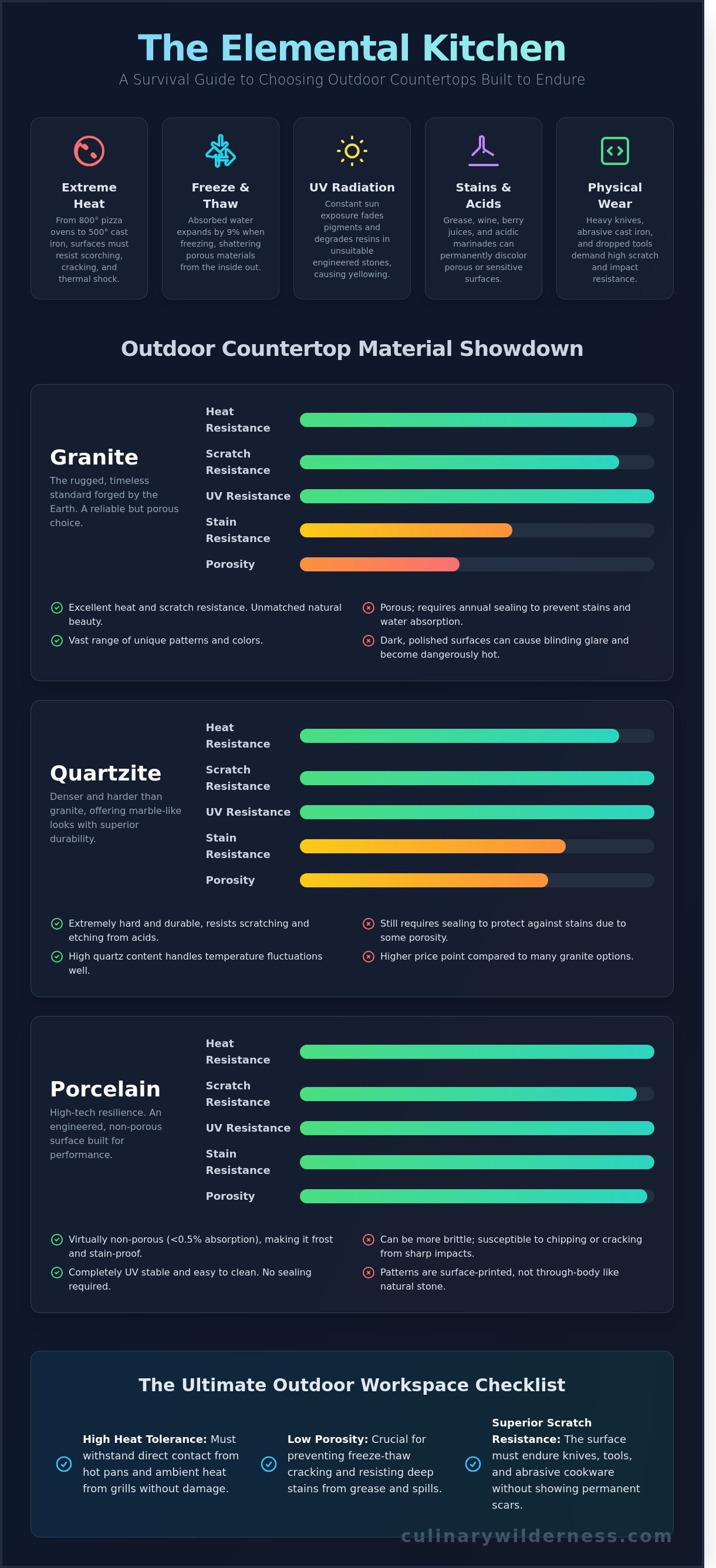
Thermal shock is a silent killer of natural stone. When a countertop surface reaches 120 degrees under a July sun and then meets a sudden, cold thunderstorm, internal stress builds rapidly. Stones with high quartz content often handle these fluctuations better than dense, dark granites that absorb and trap heat. Moisture presents an even greater threat. If a surface absorbs even 0.5% of its weight in water, that liquid will expand by 9% when the temperature drops below freezing. This internal pressure shatters the stone from the inside out during the winter months.
UV stability is equally vital for maintaining the soul of your workspace. Many engineered stones use petroleum-based binders that turn yellow or brittle when exposed to constant sunlight. You want a material that preserves its deep, earthy pigments without fading into a dull, chalky gray. A truly elemental kitchen uses materials that have already spent millions of years under the sun and ice.
The Gastronomic Workspace
Your countertop is the primary staging ground for the hunt and the harvest. This is where you clean the damp earth from morel mushrooms or butcher a fresh rack of venison. Hygiene in the wild requires a different mindset. You must prioritize non-porous surfaces near the prep area to prevent the growth of bacteria in the summer heat. A dense shield is required to protect your ingredients from the environment and vice versa.
The workspace must also endure the physical violence of a working kitchen. It needs to be as tough as your charcoal grills, capable of handling cast iron pans and heavy blades without flinching. When you're choosing materials for outdoor kitchen countertops, consider the following requirements:
- Scratch Resistance: Forged steel blades and abrasive cast iron should not leave permanent scars on your stone.
- Heat Tolerance: The surface must withstand the ambient heat of nearby embers without scorching or cracking.
- Stain Defense: Acidic juices from wild berries or tannins from oak leaves shouldn't leave a permanent ghost on the surface.
The right material creates a seamless transition between the rugged landscape and the finished plate. It's a deliberate choice that honors the ingredients and the process of discovery. By investing in quality now, you ensure your outdoor hearth remains a place of gathering for many years to come.
Natural Stone: Granite, Quartzite, and the Soul of the Earth
Choosing the right materials for outdoor kitchen countertops is a pursuit of permanence. When you cook under the open sky, you aren't just building a workspace; you're anchoring your hearth to the landscape. Natural stone provides that anchor. It's forged in the subterranean heat of the earth, making it uniquely qualified to withstand the elemental shift of the seasons. Granite, quartzite, and soapstone offer more than just utility. They bring a tactile, weathered soul to the cooking experience that synthetic slabs simply cannot replicate.
Granite: The Rugged Standard
Granite remains the timeless sentinel of the outdoor kitchen. It's a dense, igneous rock that laughs at rain and shrugs off the intense heat of a charcoal chimney. However, the finish you choose dictates your comfort. Polished granite acts like a mirror under the midday sun, reflecting blinding glare and absorbing heat until the surface is painful to touch. In direct 95-degree sunlight, a dark, polished slab can reach surface temperatures exceeding 150 degrees Fahrenheit. Opting for a honed or "leathered" finish creates a matte surface that stays cooler and hides the inevitable dust of the trail.
Color selection is equally vital for heat management. Lighter slabs, such as those with white or tan feldspar, reflect solar radiation more effectively than deep blacks or forest greens. Granite typically registers between 6 and 7 on the Mohs scale, which means your forged steel knives and heavy cast iron skillets won't leave a mark during prep. While granite is incredibly tough, your installation must still respect building code requirements to ensure the weight is properly supported and gas lines are safely integrated into the stone surround.
Quartzite and Soapstone: The Specialist's Choice
Quartzite is the sophisticated bridge between the ethereal beauty of marble and the raw strength of granite. Unlike marble, which etches when a stray lemon wedge or splash of vinegar hits the surface, quartzite is chemically stable. It resists the corrosive effects of acid rain and salt air, making it a premier choice for coastal outposts. It offers the jagged, crystalline aesthetics of a mountain peak while remaining one of the hardest materials for outdoor kitchen countertops available to the modern woodsman.
Soapstone appeals to the serious grill master for its remarkable thermal properties. It's a metamorphic rock high in talc, giving it a silky, soap-like feel, yet it's incredibly dense. Soapstone is chemically inert and non-porous, so it won't stain from red wine or wood smoke. Its heat retention is legendary; it absorbs and radiates warmth evenly, making it the perfect companion for the high-intensity environment surrounding pizza ovens. A soapstone counter near the fire stays warm long after the embers have faded, providing a cozy staging area for resting meats.
Owning natural stone requires a commitment to the passage of time. These materials aren't static. They develop a patina, a history of every meal shared and every season survived. Maintenance is a ritual of respect. Sealing your granite or quartzite every 6 to 12 months prevents moisture from penetrating the pores, while soapstone benefits from an occasional application of mineral oil to deepen its charcoal hue. If you value tools that grow better with age, consider pairing these stones with professional-grade outdoor gear that shares the same rugged DNA. Embrace the natural variations in the grain; they are the fingerprints of the earth, ensuring no two outdoor kitchens ever look the same.
Engineered Resilience: Porcelain and Concrete in the Unforgiving Sun
The sun is a primal forge. It tests the endurance of every tool we bring into the wild. When selecting the best choices for outdoor kitchen countertops, the dialogue between factory precision and raw, hand-cast form becomes vital. Sintered stone represents the pinnacle of this evolution. By 2026, market data indicates that ultra-compact surfaces will command a 12% larger share of the luxury outdoor market than they did in 2021. This shift happens because these materials for outdoor kitchen countertops mimic the molecular density of deep-earth metamorphic rock, forged at temperatures exceeding 2,100 degrees Fahrenheit. It's a calculated, high-tech response to the volatile shifts of the open air.
Modern Porcelain: The Non-Porous Powerhouse
Porcelain slabs have moved beyond the kitchen floor. Today, the industry standard has shifted toward 12mm and 20mm thicknesses for vertical and horizontal surfaces. These slabs offer a zero-porosity surface that scorns the rain. Bacteria find no purchase here. Beet juice, red wine, or the juices from a fresh hunt won't leave a ghost of a stain. When evaluating materials for outdoor kitchen countertops, porcelain stands out for its thermal shock resistance. The aesthetics are equally profound. You can find slabs that mirror weathered slate or bleached timber, allowing your workspace to vanish into the surrounding forest. This factory precision ensures a level of consistency that natural stone often lacks. It's a high-tech shield against the elements. Because it's fired at such intense heat, it's inherently UV-stable. It won't fade under the glare of a high-noon sun.
Cast Concrete: The Brutalist Beauty
Concrete is different. It's an invitation to build something that belongs to the earth. You can mold it to follow the curve of a hillside or the jagged edge of a stone wall. However, this beauty requires a pact with maintenance. Professional sealing is a non-negotiable requirement. Without a high-grade penetrating sealer applied every 12 to 24 months, salt air and cooking oils will penetrate the surface. You must embrace the patina. Small hairline cracks, often called craze cracks, appear in roughly 85% of outdoor concrete installations over time. They aren't failures; they're the story of the ground shifting and the seasons turning. For the ultimate utility, you can integrate storage drawers directly into the custom forms before the pour. This creates a seamless, monolithic structure that feels like it was unearthed rather than installed. It's heavy, permanent, and visceral.
Choosing between these two involves a trade-off between the soul of the craft and the certainty of the machine. Factory porcelain offers a 100% predictable surface. It's lighter, often weighing 30% less than traditional granite, which simplifies the logistics of a remote build. Concrete, conversely, is a labor of love. It requires on-site mastery and a willingness to let the material age. One provides a sterile, perfect stage for the culinary arts; the other becomes a part of the landscape itself. Both stand defiant against the heat, ensuring your fire is the only thing doing the cooking.
The Practical Choice: Matching Materials to Your Cooking Fire
The dance between raw flame and cold stone defines the outdoor kitchen. When you select materials for outdoor kitchen countertops, you're choosing a partner for the fire. Heat behaves differently in the wild than it does in a climate-controlled room. A granite slab might feel eternal, but without a 1/4-inch expansion gap around high-output gas grills, the thermal stress can cause hairline fractures. The stone needs room to breathe as it absorbs the 500-degree heat of a searing session. It's a physical reality that demands respect.
Ergonomics dictate the flow of the hunt. A standard 36-inch height works for prep, but a 42-inch raised tier creates a natural sanctuary for guests to gather. Depth matters too. A 30-inch deep surface allows for distinct zones. You need a "hot zone" near the flame and a "cool zone" for final plating. This spatial logic ensures that a searing hot cast iron skillet doesn't end up on the same surface as a delicate heirloom tomato salad. It keeps the chaos of the kitchen contained while the flavors develop.
Thermal Zones and Material Pairing
Materials react to the elements with varying intensity. High-density stone like quartzite offers incredible resistance near side burners, where concentrated heat from a stockpot can reach 15,000 BTUs. Use "hot zones" of natural stone or stainless steel for the heavy lifting. Transition to "serving zones" of weathered wood or polished concrete where the temperature drops. This creates a functional map of your workspace, guiding the movement from flame to plate with rhythmic precision.
Long-Term Stewardship of the Hearth
The biggest objection to high-end materials for outdoor kitchen countertops is the maintenance. Many fear that a $3,000 slab of soapstone is too fragile for the woods. It isn't. It's a living surface. A seasonal sealing ritual every 12 to 18 months preserves the deep luster of the grain. Skip the harsh chemicals; a simple solution of 5% white vinegar and warm water respects both the stone and the soil beneath your feet. It's about preserving the integrity of the material without poisoning the environment.
The "Stain Test" is a reality of the wild. Red wine spills, wood ash, and rendered duck fat will leave their mark. Don't fight them. A minor chip or an etch from a lemon wedge is a scar of a life well-lived. These marks tell the story of a 12-hour brisket or a midsummer feast. If the blemish is too deep, a 220-grit sandpaper rub followed by fresh mineral oil restores the balance. Stewardship is about presence, not perfection. You're not building a museum; you're building a hearth that will age with you.
Prepare your hearth for the seasons ahead. Explore our curated collection of outdoor cooking essentials to find your perfect match.
Completing the Landscape: Integrating Premium Appliances
The transition from a raw slab of granite or weathered soapstone to a fully functional culinary island represents the final bridge between the wild and the plate. It's the moment where the chosen materials for outdoor kitchen countertops meet the cold, hard precision of professional steel. This intersection requires more than just aesthetic alignment. It demands a deep understanding of how elemental forces like heat and weight interact with the earth's crust. A countertop is a silent partner in the dance of fire and salt. It must provide a steady, unyielding surface for the heavy work of butchery and the delicate assembly of foraged greens.
The flow of the workspace dictates the success of your outdoor sanctuary. You want a seamless transition from the prep area to the heat source. For the 2026 season, designers are prioritizing expansive, 36 inch deep surfaces that allow for both a workspace and a serving ledge. This depth provides the necessary clearance for high-output burners while keeping guests safe from the direct heat of the coals. When stone meets steel, the tolerances are tight. A gap of just 1/8 inch can collect debris and moisture, leading to structural issues over time. Precision cutting is not a luxury; it's a requirement for a kitchen intended to last for decades.
Structural Integrity for Heavy Metals
Heavy iron and steel define the rugged kitchen. A professional Santa Maria grill can easily exceed 350 pounds. This concentrated mass puts immense pressure on the underlying masonry and the countertop edges. You must ensure the substructure is reinforced with steel or high-density concrete blocks to prevent the stone from cracking under the strain of the iron. The weight is constant, but the heat is variable. This cycle of expansion and contraction is why the choice of materials for outdoor kitchen countertops remains the most critical decision in the build process.
When integrating refrigeration units, the technical requirements become even more specific. These units generate significant heat while struggling to maintain a cold interior in the summer sun. Placing a stainless steel fridge directly against a stone cutout without an insulated jacket is a recipe for mechanical failure. An insulated sleeve provides a vital 1 inch thermal buffer. This protection keeps the appliance's compressor from overworking and prevents the surrounding stone from heat-soaking. Furthermore, you must plan for 2 percent ventilation in the cabinet space to allow gas and heat to escape safely.
Plumbing and gas lines require early planning within the stone masonry. A 1/2 inch gas line for a high-BTU side burner needs a dedicated, protected path that doesn't compromise the structural integrity of the stone. Every penetration through the countertop must be sealed with high-temp silicone to prevent water from reaching the interior framing. In the rugged environment of an outdoor kitchen, moisture is the enemy of longevity.
The Final Vision: A Kitchen That Endures
The 2026 outdoor living season marks a shift toward tactile, weathered finishes that reflect the natural world. Coordinate the rough-hewn edges of your stone with durable outdoor furniture made of teak or forged iron to create a cohesive sanctuary. This isn't just a place to cook. It's a return to a more elemental way of living. The emotional reward is found in the first crackle of the wood fire against the silence of the evening. It's the peace of knowing your space was built with the same resilience as the landscape surrounding it.
Every detail, from the grain of the stone to the weight of the grill lid, contributes to a legacy of outdoor gastronomy. Your kitchen should be a testament to quality over convenience. It's time to step away from the modern indoor kitchen and embrace the raw intensity of the wild. Begin your journey to the source with Culinary Wilderness and build a space that honors the ingredients and the environment alike.
Forge Your Legacy Under the Open Sky
The scent of charred oak and the cold touch of weathered stone define the wild kitchen. Selecting the right materials for outdoor kitchen countertops turns a simple patio into a permanent altar for the elements. Granite slabs, often 3 centimeters thick, provide a heavy, ancient foundation that resists the sun's bite. Porcelain stands ready for 1,200-degree heat, offering a surface that won't crack when the embers fly. These aren't just surfaces. They're the stage for your craft.
We understand the patient wait for the perfect meal. As an authorized dealer for Fire Magic and ZLINE, we curate a selection for the Rugged Gourmet who demands precision. Our expert nationwide shipping ensures your equipment arrives ready for the flame, whether you're in the mountains or on the coast. You've chosen your stone. Now, complete the landscape with tools that match your ambition.
Design your ultimate outdoor hearth with our premium appliance collection
The fire is waiting. Step out and claim it.
Frequently Asked Questions
What is the most durable material for an outdoor kitchen countertop in 2026?
Sintered stone and high-grade porcelain remain the most durable materials for outdoor kitchen countertops in 2026. These surfaces offer 100% UV resistance and a porosity level below 0.05%. Rain and sun won't fade or crack them. They withstand the raw intensity of the elements while providing a refined space for prep. You'll find these slabs endure decades of hard use without losing their sharp, elemental edge.
Does granite need to be sealed if it’s outside?
Granite requires a fresh coat of penetrating sealer every 12 months to survive the outdoors. Without this barrier, moisture and oils from wild game or charred vegetables will seep into the stone's pores. Darker granites like Uba Tuba are denser and may resist stains longer. However, a light-colored slab can absorb liquids in under 30 minutes if the seal has failed. Proper maintenance ensures the stone remains a permanent fixture in your landscape.
Can I use quartz countertops for my outdoor kitchen?
You cannot use standard indoor quartz for your outdoor workspace. The resins holding the 90% crushed stone together will yellow and degrade when exposed to direct sunlight for more than 6 months. Some brands now offer specific outdoor-rated lines designed for UV exposure. Unless the manufacturer guarantees UV stability, the surface will eventually peel and lose its structural integrity under the sun's glare, ruining your investment.
Which countertop material stays the coolest in direct sunlight?
Light-colored natural stones like travertine or white granite stay significantly cooler in the midday sun. These materials reflect heat, keeping the surface temperature up to 30 degrees Fahrenheit lower than dark slate or soapstone. On a 95-degree day, a dark countertop can reach 150 degrees, which is hot enough to sear skin. Choosing a pale, weathered hue keeps your workspace functional and comfortable during the peak of summer.
How do I prevent my outdoor concrete countertops from cracking in winter?
To prevent concrete from cracking in sub-zero winters, you must use a high-strength 4000 PSI mix reinforced with 3/8 inch rebar. Concrete is an elemental material that breathes, but trapped moisture will expand and shatter the slab when it freezes. Apply a high-quality penetrating sealer every 2 years. This creates a hydrophobic barrier that stops 95% of water from entering the micro-pores of the stone, protecting it from the freeze-thaw cycle.
What is the best countertop material for a wood-fired pizza oven base?
Soapstone is the premier choice for a wood-fired pizza oven base because of its incredible thermal density. It can withstand temperatures up to 2000 degrees Fahrenheit without cracking. Soapstone stores heat and radiates it back into the dough for 4 hours after the fire dies down. This ancient stone feels soft to the touch but possesses a rugged resilience that thrives near the intense heat of burning oak and glowing embers.
Is porcelain or granite better for a high-use outdoor BBQ area?
Porcelain is superior to granite for high-use BBQ areas because it's completely non-porous and resists grease stains. While granite is tough, it scores a 6 on the Mohs hardness scale, whereas porcelain reaches a 7 or 8. Hot pans pulled directly from 500-degree coals won't thermal-shock a porcelain slab. It's a precise, modern surface that handles the messy, raw reality of open-fire cooking without permanent scarring or deep-set oil marks.
How much do outdoor kitchen countertops typically cost per square foot?
You should expect to pay between $50 and $150 per square foot for quality materials for outdoor kitchen countertops. Basic concrete installations start near $70, while premium granite averages $80 to $100. High-end sintered stones often exceed $120 per square foot. These prices reflect the cost of the raw material and the skilled labor required to cut and polish stone that must survive the untamed environment and the passage of time.


