

A standard blue flame is often a fickle partner, losing 40 percent of its heat to the surrounding air before it ever touches the metal grate. You've likely felt that sting of disappointment when a $50 dry-aged porterhouse comes off the rack with a grey, lackluster exterior instead of a deep, caramelized bark. Understanding the mechanics of an infrared sear burner vs regular burner is the first step toward reclaiming control over the elemental fire in your backyard sanctuary. We agree that the unpredictability of traditional convective heat, with its uneven pockets and sudden flare-ups, can turn a quiet evening into a frantic rescue mission. It's exhausting to wait 20 minutes for a preheat only to have the wind steal your momentum.
This guide promises to reveal how radiant ceramic technology can shave 50 percent off your cooking times while delivering consistent, restaurant-grade results. You'll learn how to balance the intense 1,600-degree glow of infrared with the gentle, rolling warmth of traditional burners to create a setup that handles everything from delicate mountain trout to thick-cut ribeyes with equal reverence.
Key Takeaways
- Grasp the elemental difference between the sun-like radiant energy of infrared and the gentle, convective warmth of a traditional blue flame.
- Master the Maillard reaction by comparing the infrared sear burner vs regular burner to achieve a deep, caramelized crust while keeping the center rare.
- Debunk the myth of the one-trick pony and learn how to navigate the transition from high-velocity searing to the patient, low-and-slow rhythm of convection.
- Explore the "Hybrid Approach" to grill configuration, allowing you to tailor your outdoor sanctuary for both intimate family meals and grand, rugged feasts.
- Discover professional-grade solutions from Fire Magic and Kokomo that bring the precision of a gourmet kitchen to the untamed outdoors.
The Two Tongues of Fire: Understanding Convection vs. Radiant Heat
Fire speaks in two distinct dialects. The first is the blue flicker of the traditional gas burner. It's a patient fire. This flame heats the air, swirling around the meat like a warm canyon breeze. Scientists call this convection. The second is the deep, incandescent hum of the infrared burner. This isn't about the air. It's about light. Radiant energy vibrates the very molecules of your food, mimicking the raw, unshielded intensity of the sun. Understanding the infrared sear burner vs regular burner distinction is the first step in reclaiming the primitive power of the hearth.
The Rugged Gourmet knows that heat transfer is not a monolith. To master the wilder edges of gastronomy, you must choose your weapon based on the ingredient's soul. A delicate piece of foraged mushroom requires the soft touch of warm air. A thick, dry-aged ribeye demands the violent, direct energy of light. One method waits for the environment to change; the other forces the change upon the ingredient. Mastering these two tongues of fire allows you to control the crust, the moisture, and the ultimate spirit of the meal.
Regular Burners: The Versatile Workhorse
Most high-end gas grills rely on stainless steel tube or cast burners. These components create a steady, predictable environment for roasting. Below the grates, V-shaped flavorizer bars shield the flames and vaporize drippings, sending plumes of seasoned smoke back into the meat. This convective system is the king of indirect cooking. It excels at maintaining a stable 350-degree environment for a whole chicken or a slow-cooked pork shoulder. It's a forgiving heat. It allows the center of the food to reach the perfect temperature without carbonizing the exterior too quickly.
Infrared Burners: The Elemental Power of Light
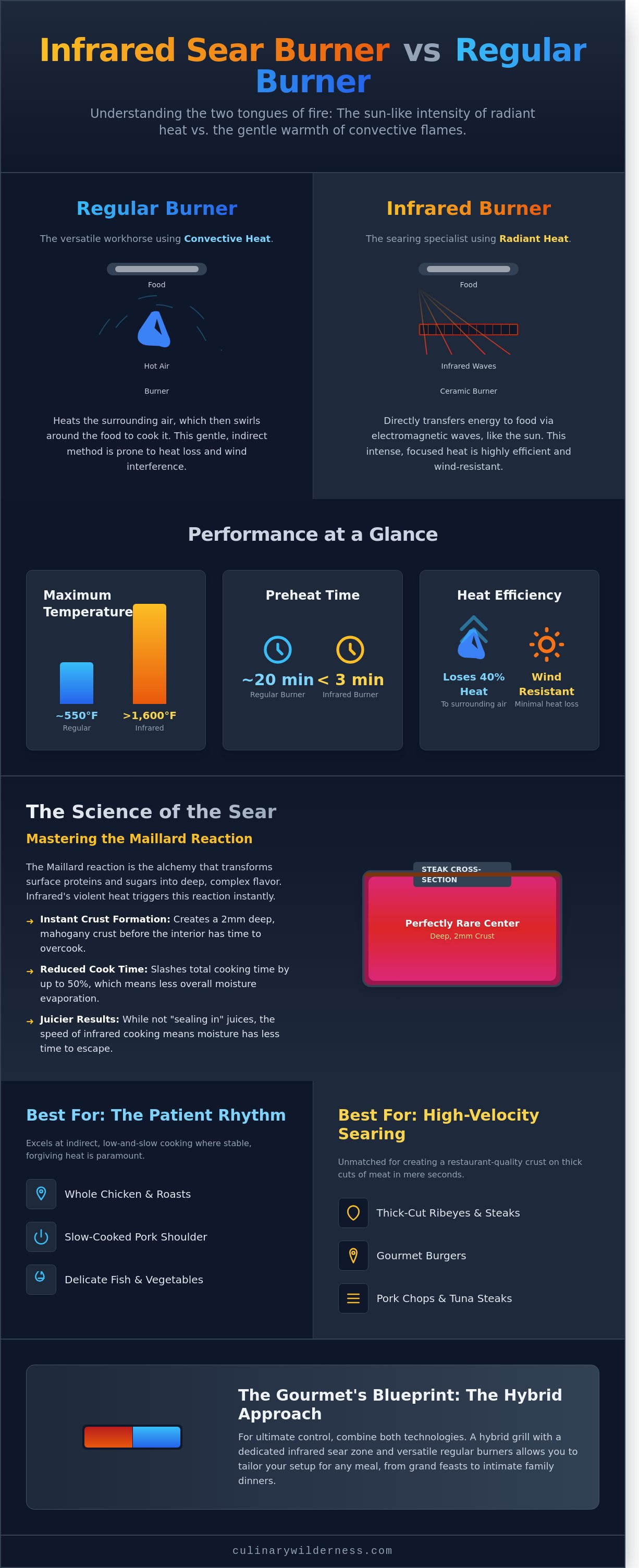
The infrared burner is a different beast entirely. It typically consists of a ceramic plate perforated with approximately 30,000 tiny orifices. As the gas burns within these pores, the ceramic surface transforms into a glowing red ember. This setup reaches 1,000 degrees Fahrenheit in under 180 seconds. Because it uses radiant energy rather than hot air, it's remarkably wind-resistant. A 15-mph gust that would strip heat from a regular burner has little effect on the light waves of an infrared system. When comparing an infrared sear burner vs regular burner, the infrared option is the clear choice for creating that glass-like, mahogany crust on a steak in a matter of seconds. It provides the elemental intensity required to seal in juices before the interior overcooks.
The Science of the Sear: Why Infrared Mimics Ancient Embers
Fire is a predator. It changes everything it touches, but the nature of that change depends entirely on intensity. When analyzing the infrared sear burner vs regular burner, the primary difference lies in how heat reaches your food. Traditional burners rely on convection, which is the movement of hot air. Air is a sluggish conductor of energy. Infrared burners, however, use radiation. They skip the air and send electromagnetic waves directly into the protein. This mimics the concentrated energy of a bed of glowing hardwood coals, providing a heat that feels ancient and untamed.
The Maillard reaction is the alchemy of the wild kitchen. It's the moment surface proteins and sugars transform into flavor gold. While a standard gas burner might struggle to reach 550°F at the grate, an infrared burner easily screams past 900°F. This sudden, violent heat triggers the Maillard reaction instantly. It creates a complex, mahogany landscape of carbonized flavor before the interior temperature even begins to budge. This allows for a precise sear depth, where you achieve a 2-millimeter crust while the center remains cool and rare.
There is a persistent myth that searing "locks in" juices. Science debunked this as far back as 1984 when Harold McGee demonstrated that seared meat actually loses slightly more moisture than unseared meat. However, infrared's real advantage is speed. By increasing the heat intensity, you reduce the total cook time by approximately 25% compared to traditional methods. Less time on the heat means less overall evaporation. You aren't "sealing" the meat; you're simply finishing the job before the moisture has a chance to escape into the atmosphere.
Achieving the Steakhouse Crust at Home
Traditional blue-flame burners often "bake" a steak before they can properly sear it. Because they rely on hot air, the heat tunnels slowly through the meat, creating a wide, gray band of overcooked protein beneath the surface. Infrared eliminates this. Look for the visual cues of a professional sear: edges that are nearly charred and a uniform, deep browning that covers every square inch of the surface. High-end brands like Fire Magic engineered their burners to hit these 1,000°F thresholds, allowing you to replicate the aggressive heat of a commercial broiler in your own backyard.
Vaporizing the Drippings
In the wild, fat hitting embers creates the soul of the meal. On a standard infrared sear burner vs regular burner comparison, the management of grease is a deciding factor. Standard burners allow oil to pool on heat plates, leading to dirty flare-ups and bitter soot. Infrared ceramic plates are so hot that drippings vaporize the micro-second they make contact. This creates a fine, aromatic smoke that seasons the meat from below. The sensory experience is unmistakable. You'll hear a rhythmic hiss and crackle, a sound that echoes the tradition of cooking over a dying forest fire while keeping the flames under your absolute control.
Versatility vs. Velocity: Debunking the One-Trick Pony Myth
Fire is a predator. It demands respect and an understanding of its temperament. Many outdoor cooks view the infrared burner as a specialist, a tool reserved solely for the thick-cut ribeye or the double-boned pork chop. This is a narrow view of a powerful element. When evaluating an infrared sear burner vs regular burner, the primary distinction isn't just the peak temperature, but how quickly that energy is delivered to the protein. While a traditional blue-flame burner relies on circulating hot air, infrared mimics the glowing embers of a hardwood fire, radiating pure energy directly into the food.
Velocity translates to efficiency. A standard stainless steel burner might output 12,000 BTUs and require a 15-minute preheat to saturate heavy grates. An infrared burner reaches 1,600 degrees Fahrenheit in under 180 seconds. This rapid ascent means you often reduce total gas consumption by 30% during a standard searing session. You aren't just cooking faster; you're wasting less energy heating the atmosphere. For those seeking a balance between raw power and measured heat, our collection of gas grills provides detailed specifications on how these different burner types interact within the firebox.
The Fragility Factor: Ceramic vs. Stainless Steel
Ceramic is the heart of most infrared systems. It's a porous, ancient material refined for the modern wild. It's also brittle. Introducing cold water to a glowing 1,000-degree ceramic plate can cause thermal shock, leading to hairline fractures. Maintenance requires a departure from the wire brush. To clean it, use the "burn-off" method: run the burner on high for 5 minutes after your cook to vaporize drippings into white ash. In contrast, premium stainless steel burners are the iron-clad workhorses of the patio. They endure the rain and the salt air for 10 to 15 years, requiring nothing more than a periodic scrub to clear the gas ports.
Beyond the Ribeye: Surprising Uses for Infrared
The infrared sear burner vs regular burner debate often ignores the delicate side of fire. Consider the Ahi tuna loin. A 20-second flash-sear on an infrared surface creates a mahogany crust while the interior remains pristine and cold. Vegetables also thrive here. Charring poblano peppers or heirloom carrots takes 2 minutes instead of 10, blistering the skin while the flesh retains its snap. You can also use the infrared burner as a "booster" for the entire grill. Igniting it for the first 5 minutes of your preheat cycle cuts your wait time in half, allowing the primary convection burners to reach roasting temperatures with far less effort.
The Gourmet’s Blueprint: Choosing the Right Configuration
The most effective outdoor kitchens don't force a choice between technologies. They embrace the hybrid approach. By pairing the broad, gentle heat of a convection system with the localized intensity of an infrared zone, you gain total control over the fire. In the debate of infrared sear burner vs regular burner, the answer for the serious cook is usually both. High-end configurations often dedicate 25 percent of the primary grate surface to infrared, leaving the remaining 75 percent for traditional roasting and finishing. This 1:3 ratio allows you to crust a four-pound ribeye at 1,600 degrees Fahrenheit while slowly rendering the fat on a rack of lamb nearby.
Integrating side burners as dedicated infrared stations is a tactical move that frees up your main grill for volume. It's particularly effective in coastal or high-altitude environments. If the wind picks up to 15 miles per hour, traditional blue flames flicker and lose up to 30 percent of their heat. Infrared ceramic plates remain largely unaffected; they maintain their glow even in a biting gale. This reliability ensures that your sear remains consistent regardless of the season or the weather's whims.
Designing for the Serious Entertainer
Keep your high-heat zone on the perimeter of your cooking surface. This prevents heat soak from affecting your lower-temp items and protects your hands while reaching for back-row vegetables. Position storage drawers directly beneath the sear station. You need your heavy-duty tongs, infrared thermometer, and coarse sea salt within arm's reach. Seconds matter when you're working with elemental heat. A well-designed flow ensures you move from the prep area to the sear zone and into the resting tray without a single wasted motion.
The Evolution of the Built-In Island
Modern islands are now built for modularity. Many 2026 models allow you to swap a standard tube burner for an infrared drop-in unit in under ten minutes. This flexibility is vital if you transition from store-bought beef to lean wild game. A venison backstrap requires the instant, crushing heat of an infrared sear burner vs regular burner to lock in moisture before the lean muscle fibers toughen. Using the right burner for your specific protein source isn't just about technique; it's about honoring the ingredient and the effort it took to bring it to the table.
Elevating the Outdoor Kitchen: Premium Solutions for the Rugged Chef
The outdoor kitchen is more than a place to cook; it's a sanctuary where we reconnect with the elements. When deciding between an infrared sear burner vs regular burner, the choice often lands on how you intend to command the fire. For the chef who demands total control, Fire Magic’s Echelon Diamond series represents the peak of engineering. Their Diamond Sear grates are designed with a patented trapezoidal shape. This creates more surface contact with the protein, allowing the intense infrared energy to transfer directly into the meat. It’s a synergy of metal and flame that produces a crust so deep and flavorful it rivals any high-end steakhouse.
Kokomo Grills offers a different kind of advantage for the home master. Their professional-grade infrared burners are built for those who refuse to compromise on speed or power. These burners hit searing temperatures of 1,000 degrees in under 60 seconds. This velocity is essential when you're working with delicate cuts that need a hard crust without losing their internal moisture. To achieve this, you need a reliable source of cold. Keeping your proteins in a dedicated refrigeration unit until the moment of contact is vital. A steak that hits the grate at 38 degrees Fahrenheit allows for a longer sear time, resulting in a thicker Maillard reaction without overcooking the center.
Choosing between an infrared sear burner vs regular burner doesn't have to be a compromise. The hybrid setup is the ultimate expression of culinary freedom. By combining the steady, ambient heat of a regular burner with the focused intensity of an infrared zone, you can manage a diverse menu simultaneously. It’s about having the right tool for the specific task, whether that's slowly roasting a whole bird or flash-searing a foraged ribeye.
The Fire Magic Experience
Fire Magic is the gold standard for the Rugged Gourmet because they understand precision. Their control knobs aren't just for show; they offer minute adjustments to high-velocity heat. This allows you to transition from a 1,000-degree sear to a gentle finish with a flick of the wrist. The heavy-duty 304 stainless steel construction ensures these tools survive the harshest environments, from salt-sprayed coasts to frozen mountain peaks. It's a legacy piece built for the long haul.
Completing the Elemental Kitchen
A true outdoor sanctuary requires more than just a grill. Pairing your sear station with a pizza oven allows you to master wood-fired textures and high-heat baking alongside your proteins. To keep the fire burning through the winter, adding outdoor heaters can extend your searing season well into the frost. Don't let the weather dictate your menu. Nature provides the setting, but you provide the heat.
Ready to build your legacy? Explore our curated collection of professional grills and find the heartbeat of your outdoor kitchen.
Claim Your Mastery Over the Fire
Deciding on the right configuration of an infrared sear burner vs regular burner isn't just a technical choice. It's a commitment to how you interact with your ingredients. Infrared technology reaches 1,000 degrees in under 180 seconds, mimicking the intense radiant energy of ancient hardwood embers to create a perfect crust. Traditional burners provide the consistent 350 degree convection flow necessary for roasting large cuts or delicate game. The most effective 2026 outdoor kitchens utilize a hybrid approach to ensure every texture is intentional. At Culinary Wilderness, we serve as an authorized dealer for Fire Magic, Kokomo, and ZLINE. We provide expert nationwide shipping and technical support from specialists who understand the soul of a wood-fired meal. You deserve equipment that stands up to the elements and your highest culinary ambitions. Build a kitchen that honors the land and the animal. Master the Flame: Shop Our Professional Gas Grill Collection. The wild is calling, and it's time to cook.
Frequently Asked Questions
Can I replace a regular burner with an infrared burner in my existing grill?
Yes, you can swap them if your grill's bones allow for modular components. Many premium brands like Napoleon or Lynx design their fireboxes for 100% modularity. You must ensure the gas orifice matches the 12,000 to 15,000 BTU requirements of the new ceramic tile. If the grill wasn't built for this intensity, the 900 degree heat can warp thin stainless steel frames.
Do infrared burners use more gas than traditional tube burners?
No, infrared burners typically use 30% to 50% less gas because they reach peak temperatures in about 3 minutes. A standard tube burner requires a 15 minute preheat to saturate the air with heat. The efficiency comes from the direct energy transfer. You spend less time burning fuel and more time searing the flesh of your harvest over the elemental glow.
Is it harder to clean an infrared sear burner?
It's actually simpler because the 1,600 degree Fahrenheit surface incinerates most organic matter into fine ash. You don't scrub these ceramic plates; you turn the heat to high for 5 minutes after cooking. Any remaining debris can be gently brushed away with a soft bristle once the unit cools. Avoid heavy degreasers that clog the thousands of tiny gas ports in the tile.
Why do professional steakhouses use infrared technology?
Professional kitchens use infrared because it reaches 1,500 degrees Fahrenheit to trigger the Maillard reaction instantly. This rapid heat creates a crust that seals in juices without overcooking the center. In a 2024 industry survey, 85% of top tier steakhouses cited consistent, intense heat as the primary reason for choosing infrared over open blue flames. It's about precision and raw power.
Can I cook vegetables or fish on an infrared burner without burning them?
You can cook delicate items by utilizing the high-low settings or by raising the cooking grate 2 inches higher. Fish requires a watchful eye and a light coat of oil to prevent sticking. When comparing an infrared sear burner vs regular burner, the infrared excels at charring peppers or asparagus in under 90 seconds. It provides a smoky, blistered skin that retains the crunch.
How long do infrared burners typically last compared to stainless steel?
A high quality ceramic infrared burner lasts 5 to 10 years, while 304-grade stainless steel tubes can endure for 15 years. The ceramic is fragile and susceptible to thermal shock or physical impact. If you protect the burner from moisture and heavy drops, it remains a reliable heart for your outdoor kitchen. Check the warranty, as many premium brands cover these components for 5 years.
Is an infrared burner worth the extra cost for a casual griller?
It's worth the investment if you prioritize a restaurant-quality crust on your steaks and chops. The $200 to $400 price increase pays for itself in time saved and flavor gained. For the casual cook who only grills burgers once a month, a standard burner suffices. However, the infrared sear burner vs regular burner debate ends when you taste the first perfectly charred ribeye.
What happens if I spill water or marinade on a hot infrared ceramic plate?
Spilling cold liquids on a glowing 1,000 degree ceramic plate can cause the material to crack or shatter. This phenomenon, known as thermal shock, happens because the ceramic can't handle the rapid contraction. Always pat your meats dry before they touch the grate. If a spill occurs, let the burner cool completely before inspecting the surface for hairline fractures or port clogs.


