

Your backyard isn't just an extension of your home. It's the untamed edge where civilization meets the wild, a place where fire, stone, and steel converge. We know you feel it, too. That deep-seated pull to cook under an open sky, to hear the sharp hiss of meat over live flame, far from the sterile confines of an indoor kitchen. Yet the dream of a permanent outdoor hearth can feel daunting, tangled in the fear of miscalculating dimensions for a Fire Magic grill or confusion over the raw power of a gas line.
This guide strips away that uncertainty. Here, you'll master the art of creating professional-grade built-in grill station plans, forging a culinary sanctuary that balances rugged durability with absolute precision. We'll cut through the noise of material choices and provide a clear blueprint, giving you the confidence to build an outdoor kitchen that feels less like an addition and more like a return to the source.
Key Takeaways
- Master the elemental flow of your outdoor kitchen by applying the professional 'Cold-Hot-Wet-Dry' zone methodology for ultimate efficiency.
- Discover why 304 stainless steel is the non-negotiable choice for enduring the elements and how to select a grill that matches your cooking style.
- Explore different approaches to your built-in grill station plans, from ready-to-finish frames for speed to modular systems for future flexibility.
- Learn the essential seasonal rituals required to protect your culinary sanctuary from the raw intensity of the weather and maintain its rugged beauty.
The Philosophy of the Built-In Grill Station
There comes a time to move beyond the temporary. To leave the wobbly, wheeled cart in the past. The transition from a portable grill to a permanent outdoor kitchen is more than an upgrade; it’s a culinary rite of passage. It’s a declaration that you are creating a dedicated space for the elemental dance of fire and food. This is the philosophy of the Rugged Gourmet: a deliberate fusion of raw, outdoor intensity with the precision of refined gastronomy. A well-conceived station, born from thoughtful built-in grill station plans, becomes an anchor for your home, a hearth that improves everything from heat control to the very flow of a summer evening.
A permanent structure is a superior cooking instrument. The thermal mass of stone, brick, or concrete provides a level of heat retention that a thin-walled metal cart, weighing maybe 50 pounds, can never achieve. This stability is the key to mastering low-and-slow smoking or achieving a perfect, edge-to-edge sear. The ergonomics are fundamentally better, built to your body and your process. Counters are at the correct height. Storage is within arm’s reach. The workflow is intuitive, a seamless extension of your culinary instincts. This structure also transforms your patio from a space with furniture into an outdoor room with a purpose. It becomes a natural gathering point, a magnetic center that draws people in and directs the social energy of any event.
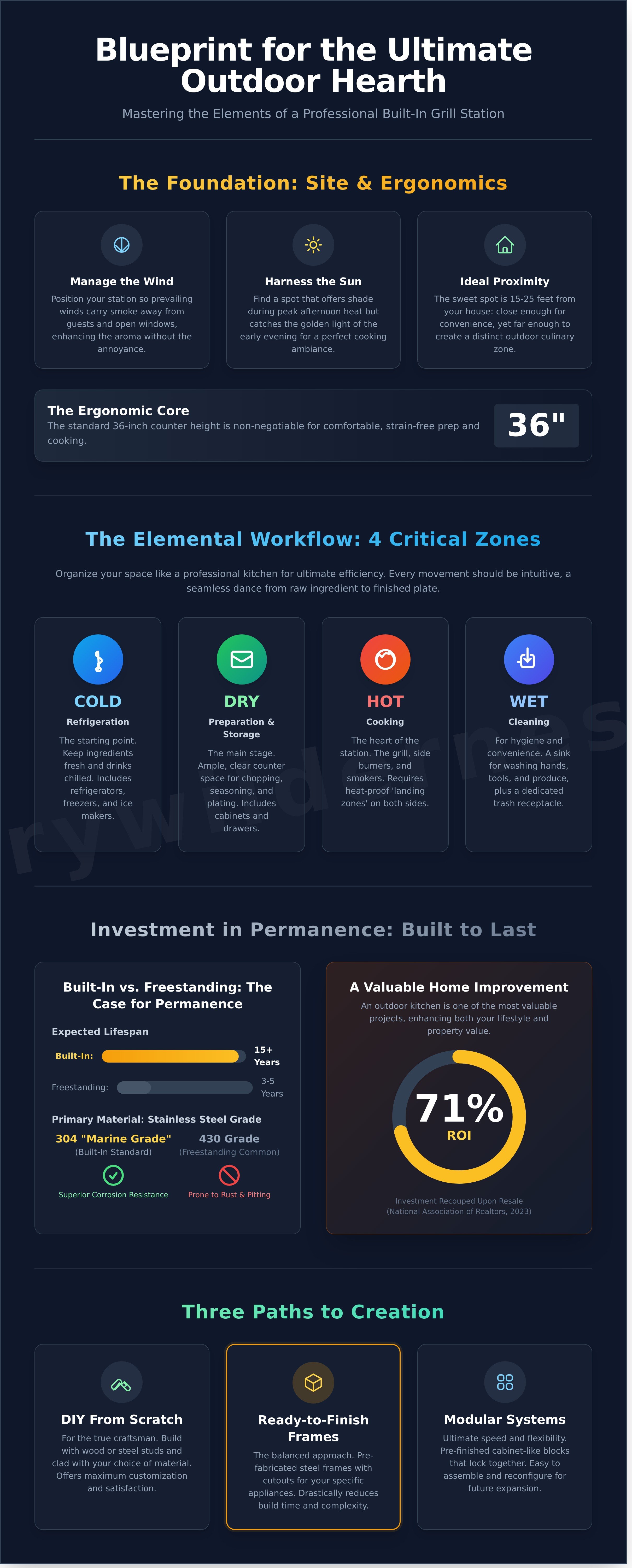
Establishing the site is the first, most critical step. Before a single stone is laid, you must learn to read the land. Spend a week observing the prevailing winds; you want them to carry the savory smoke toward the far end of the yard, not back into your guests' faces or through an open kitchen window. Watch the path of the sun. The ideal spot will offer shade during the intense heat of a 3 p.m. cookout but allow the golden light of early evening to illuminate your workspace. Finally, consider its relationship to the house. A 15 to 25-foot distance is often the sweet spot-close enough for easy transport of ingredients, yet far enough to establish a distinct outdoor culinary zone.
Built-In vs. Freestanding: The Case for Permanence
The argument for permanence begins with longevity. Your average freestanding grill, often made with 430-grade stainless steel, may last 3 to 5 years before succumbing to the elements. A built-in grill head, engineered with marine-grade 304 stainless steel and sheltered within a masonry structure, is built for a 15-year-plus lifespan. It's an investment in durability. Psychologically, it represents a profound shift. You are no longer just using an appliance; you are returning to a dedicated sanctuary for cooking. This act connects us to something ancient, as The history of outdoor cooking is fundamentally rooted in the creation of permanent, communal hearths. This investment extends to your property's value. A 2023 report from the National Association of Realtors found that homeowners who install an outdoor kitchen can expect to recoup over 71% of their investment upon resale, making it one of the most valuable home improvement projects.
The Sensory Experience of Outdoor Cooking
A great outdoor kitchen engages every sense. The crackle of embers. The sharp hiss of steak hitting hot grates. The design of your station directly impacts this acoustic environment. Hard, dense materials like granite will reflect sound, amplifying the satisfying audio of the cook. This is about designing for the complete experience. Aroma is managed by harnessing the wind, turning a potential nuisance into an asset that pulls the rich scent of charred wood and rendered fat away from the dining area. The materials themselves offer a tactile connection to the natural world. The cool, rough texture of fieldstone, the solid heft of a cast iron handle, the smooth grain of a weathered cedar countertop-these elements feel grounded, real, and deeply connected to the wild world you’re cooking in.
The Anatomy of a Professional Grill Station Plan
A true outdoor kitchen is born from the earth up. It’s more than stacked stone and a gleaming steel lid; it’s an ecosystem designed for a primal, elemental rhythm. The best built-in grill station plans aren't just about aesthetics. They are blueprints for efficiency, safety, and a seamless connection between you and the fire. Before a single stone is laid, you must understand the unyielding principles that govern the space.
The entire structure is built around a core ergonomic truth: the 36-inch counter height. This isn't an arbitrary number. It’s the standard for indoor kitchens, a height proven for comfortable prep work and tool handling, preventing the stooping that breaks an outdoor chef's focus. From this foundation, we map the terrain using the ‘Cold-Hot-Wet-Dry’ zone methodology. Think of it as creating a natural workflow: Cold for refrigeration, Hot for the grill itself, Wet for the sink, and Dry for the expansive prep surfaces. This layout ensures every movement is intuitive, a deliberate dance from raw ingredient to finished plate without wasted steps.
Mastering the Dimensions
Every grill needs a 'landing zone', a heat-proof surface to receive searing steaks or a full tray of charred vegetables. Plan for a minimum of 18 inches of uninterrupted counter space on at least one side of the grill, with 24 inches being ideal. The depth of your island is dictated by the untamed power of your chosen appliance; professional series grills like those from Fire Magic or ZLINE often demand a depth of 24 to 30 inches to house their mechanics. The entire layout hinges on the outdoor Work Triangle, which establishes an efficient path between your grill, sink, and primary preparation surface.
Respect for the fire is paramount. High-BTU appliances are the heart of your station, and they demand breathing room. The National Fire Protection Agency (NFPA) guidelines and nearly all manufacturer warranties mandate specific clearances to combustibles. This is non-negotiable. A minimum of 18 inches must separate your grill from any flammable structure, like wood siding or a deck railing. Within the island itself, ventilation is just as critical. Propane is heavier than air and will pool at the bottom of an enclosed island, creating a bomb. Natural gas is lighter and will rise. Your island must have vents to prevent this buildup; a common rule is to install at least two vents, one high and one low on opposing sides, for every 48 inches of enclosed cavity space.
Essential Utilities: Gas, Power, and Water
Your station’s lifeblood flows through its utility lines. A permanent natural gas line offers an endless fuel source, but requires trenching and a professional connection. A 20-pound propane tank offers flexibility, but needs an accessible, vented cabinet. Your electrical needs will always be greater than you anticipate; install a minimum of two duplex GFCI-protected outlets to safely power rotisseries, smokers, and lighting. Finally, an integrated sink requires planning for both a water supply and drainage, which may involve tying into your home’s main drain or installing a dry well for gray water, subject to local building codes effective since 2021.
These foundational elements are the grammar of a well-designed outdoor kitchen. They create a space that feels less built and more grown, a natural extension of your culinary ambition. For those seeking to master this elemental craft, our collection of expedition-grade outdoor kitchen blueprints provides a weathered map to begin your journey.
Selecting Your Elemental Tools: Grills and Accessories
The heart of your outdoor kitchen is not an appliance. It is a fire. Tamed, controlled, but a fire nonetheless. The grill you choose dictates the rhythm of your cooking, the flavor of your food, and the very soul of your station. Your built-in grill station plans must pivot around this central element, the forge where raw ingredients are transformed by flame.
Are you a hunter of the perfect sear, a master of the fast, violent char? Or do you follow the slow path, the patient art of smoke and time? Your answer defines your grill. For the searing purist, nothing beats the immediate, blistering heat of an infrared burner, which can exceed 900°F in minutes. For the low-and-slow disciple, a grill with heavy-gauge construction and precise airflow control is paramount for maintaining the sacred 225°F to 275°F smoking window for hours on end.
This tool must withstand the wild. Wind, rain, sun. That is why 304-grade stainless steel is not a luxury; it's a necessity. Composed of 18% chromium and 8% nickel, this alloy forms a passive, corrosion-resistant layer that cheaper steels like 430-grade simply cannot match. It’s the armor your station wears against the relentless march of the seasons.
Beyond the primary fire, your station needs support. A power burner, roaring with up to 60,000 BTUs, can handle a cast-iron pot of simmering stock or a crab boil for the entire clan. Integrated storage is not about convenience, it’s about control. Weather-sealed pantry inserts protect your spices from damp morning air. Heavy-duty drawers hold your knives and tongs, ready at a moment’s notice. Every component must earn its place.
Mastering flavor also means mastering your ingredients, from the cut of the meat to the complexity of your rubs. Many seasoned pitmasters incorporate artisan coffee into their creations for a deep, smoky flavor that enhances beef and pork. For those looking to elevate their pantry with that kind of small-batch quality, it's worth it to learn more about The Roast Haus Coffee Co..
The Professional Grill Selection
Your choice of grill is a statement. A commitment. These brands have been forged in the fires of professional demand, each offering a different path to mastery for those who take their outdoor cooking seriously.
- Fire Magic: The old guard. Crafting grills in California since 1937, their legacy is built on precision engineering and materials that last a lifetime. Their cast stainless steel “E” burners are legendary for even heat distribution, a testament to their unwavering commitment to performance.
- The Workhorse: For those who prioritize raw power and unwavering durability, there are brands that focus on robust, heavy-gauge 304 stainless steel construction and high-BTU burners. These grills are engineered for relentless performance, stripping away unnecessary frills to deliver pure, unadulterated cooking capability, ideal for the demanding outdoor chef.
- ZLINE: The modern blade. For the chef who values form as much as function, ZLINE brings a sophisticated, minimalist aesthetic to the untamed outdoors. Their polished finishes and clean lines conceal a ferocious cooking power, blending seamlessly into contemporary built-in grill station plans.
Beyond the Main Burner
A truly functional station anticipates every need, integrating specialized tools that expand your culinary territory and conceal the mundane necessities of a working kitchen.
- The Wood-Fired Pizza Oven: This is more than an add-on; it's a return to an ancient craft. Reaching temperatures over 750°F, a proper wood-fired dome can cook a Neapolitan pizza in under 90 seconds, imparting an unmistakable, smoky flavor that gas cannot replicate.
- Outdoor Refrigeration: Keeping ingredients at their peak requires protection from the elements. A UL-rated outdoor refrigerator is engineered to maintain precise temperatures even when the ambient air swings from a chilly 40°F to a blistering 100°F, ensuring your foraged mushrooms and fresh-caught fish remain pristine.
- Trash Bins and Propane Slides: The best design makes the unappealing disappear. Integrated pull-out trash bins and concealed propane tank slides maintain the clean, elemental aesthetic of your stone and steel, keeping the utilitarian hidden from view.
Three Paths to the Build: From DIY to Prefab
The blueprint is one thing. The build is another. It’s where vision meets sweat, where lines on paper become a hearth of stone and steel. There are three primary trails to your destination, each with its own terrain. Your choice depends on your timeline, your skill, and the permanence you seek. Whether you choose a modern frame or ancient stone, solid built-in grill station plans are your essential map.
The RTF Advantage
A Ready-to-Finish (RTF) frame is the skeleton of your station, delivered. These aren't flimsy kits. They're engineered from 18-gauge G90 galvanized steel, a material specified to resist the corrosion and moisture projected for the 2026 climate and beyond. It’s a rot-proof foundation that won't warp or decay. Once the frame is anchored, you clad it in a skin of your choosing: thin-set stone veneer for a mountain lodge feel, smooth stucco for a desert oasis, or reclaimed brick for a weathered, industrial edge. The timeline is compressed. From delivery to the first sear, a skilled DIYer can complete the project in a single weekend, around 16-20 hours of focused work.
Building from the Earth: Masonry Basics
For elemental permanence, nothing rivals masonry. This is the path of patience. It begins by anchoring your station to the earth with a 4-inch thick reinforced concrete slab, strengthened with a grid of #3 rebar. This foundation prevents the shifting and cracking that winter freezes and summer thaws can inflict. The build itself is a dialogue between cinder block, mortar, and stone. For an unpretentious, weathered look, choose irregular fieldstone and use a "full-joint" mortar technique, allowing the mortar to squeeze out slightly, mimicking structures built a century ago. When framing the grill cutout, a 3-inch steel lintel is essential to bridge the opening and bear the weight of the courses above, ensuring the integrity of your stonework for decades. For a deeper dive into foundational work and material selection, explore our complete Field Guide to Outdoor Masonry.
Modular islands offer a middle ground, a flexible compromise. These pre-built sections arrive ready to connect, allowing you to configure your layout and adapt it if your landscape changes. They provide structure without the permanence of a concrete foundation.
A final, critical note on construction: Fire demands respect. When using any combustible materials in your frame, like pressure-treated wood, an insulated jacket is not an option; it's a mandate. This stainless steel sleeve creates a 1.5-inch air gap, a non-combustible barrier between the raw 700°F heat of your grill and the structure that holds it. It is the single most important safety component in your built-in grill station plans, a silent guardian against the untamed element at its heart.
Living with the Grill: Maintenance and Mastery
The fire dies to embers. The feast is done. But your connection to this elemental space doesn't end there. A well-made outdoor kitchen is a living part of your landscape, a testament to craftsmanship that demands stewardship. To master the grill is to understand its lifecycle, to care for it through the quiet of winter and the bleached-out sun of summer. This isn't a chore; it's a ritual that honors your investment and prepares the station for the next flame.
The best built-in grill station plans account for this endurance, ensuring the materials and design can weather the seasons with grace. Your role is to become the keeper of that legacy.
Preserving the Steel
High-grade 304 stainless steel, the heart of appliances from Fire Magic and ZLINE, is chosen for its resilience. It breathes with the elements. But even this stalwart material can develop a patina. In coastal or humid areas, you may see 'tea staining', a light brownish film caused by surface-level oxidation of salt and moisture deposits. This is not rot. On lesser metals, iron atoms react with oxygen and water in an electrochemical process called oxidation, forming the flaky, corrosive decay we know as rust. True 304 steel resists this invasive decay, but it requires your attention to maintain its untarnished gleam. The ritual of the clean is simple:
- For routine care, a soft cloth with warm, soapy water, wiping with the grain of the steel, is all you need.
- For tougher grease or that developing tea stain, use a dedicated, non-abrasive stainless steel cleaner. Fire Magic offers its own proprietary Stainless Steel Cleaner, while a paste of baking soda and water or Bar Keepers Friend Soft Cleanser works exceptionally well on ZLINE surfaces.
- Never use steel wool or abrasive pads; they will scratch the surface and invite corrosion.
After cleaning, protect it. A high-quality, breathable grill cover is essential. It deflects rain and UV rays while allowing moisture to escape, preventing the damp, stagnant air that accelerates surface corrosion. Think of it not as a blanket, but as a rugged shell against the storm.
Completing the Atmosphere
With the station preserved, you can turn to the final, living touches that transform a cooking area into a true wilderness experience. Light is your primary tool. You need both task lighting, the focused, brilliant beam of an overhead LED or grill-mounted light that lets you see the precise moment a steak reaches a perfect medium-rare, and ambient lighting. This is the low, warm glow from a crackling fire pit, the soft wash of hardscape lights on stone, or the gentle pulse of string lights overhead. One is for precision; the other is for setting the mood, for drawing people in from the darkness.
Surround your station with furniture that feels like it belongs. Weathered teak, cast iron, and stone echo the primal materials of your built-in grill station plans. Add a fire pit not just for warmth, but as a gathering point for stories after the meal is done. This is how you create a cohesive world, an outpost where the wild and the refined meet. It’s the final act of creation, turning a functional structure into the heart of your domain.
Your station is built. Now, it's time to bring it to life with the fire it deserves. Discover the professional appliances that will define your outdoor station and begin your journey.
Forge Your Elemental Hearth
Your outdoor kitchen is more than a project; it's a return to the source. A sanctuary where fire, food, and the wild converge. You've seen how a detailed blueprint is the map to your domain, and how the right elemental tools are the heart of your built-in grill station plans. The path is clear.
The final piece is the fire itself. As specialists in professional-grade outdoor kitchen components, we connect you to that untamed flame. We are an authorized dealer for 3 of the industry's most durable brands: Fire Magic, Kokomo, and ZLINE. We ensure your hearth arrives with expert nationwide shipping for all our luxury outdoor appliances. It's time to choose your fire. Explore our curated collection of professional built-in grills and find the soul of your sanctuary.
The wilderness is waiting. Your story is ready to be written in smoke and flame.
Frequently Asked Questions
What is the best material for a built-in grill station frame?
Steel studs, specifically 20-gauge galvanized steel, provide the strongest, most enduring skeleton for your grill station. Unlike pressure-treated wood, which can warp over time and remains combustible, steel stands unyielding against both fire and moisture. It won't rot, twist, or succumb to the relentless cycle of seasons. This elemental resilience ensures your outdoor hearth remains a solid, reliable centerpiece for decades of use, a testament to building with foresight and quality welding—a process managed in professional fabrication shops with software like SOCWeld.
Do I really need a vent hood for my outdoor built-in grill?
A vent hood is absolutely essential for any grill station tucked beneath a roof or combustible overhead structure. Fire demands respect. Without proper ventilation, smoke, grease, and intense heat become trapped, creating a significant fire hazard and staining your structure. Building codes, like the International Residential Code (IRC) Section G2447, often mandate a minimum 36-inch clearance from combustibles, a standard a vent hood helps you safely manage while channeling the wildness of the flame.
How much does it cost to build a luxury outdoor grill station in 2026?
Expect to invest between $15,000 and $35,000 for a luxury outdoor grill station in 2026. The final tally depends on your chosen elements. A high-performance 42-inch grill can run $7,000 alone. You must also factor in natural stone veneer at over $50 per square foot and durable granite countertops starting at $100 per square foot. This isn't just an expense; it's an investment in a permanent, elemental cooking space built to weather the years.
Can I use a regular freestanding grill in a built-in enclosure?
No, you cannot safely use a standard freestanding grill within a built-in enclosure. It's a severe fire risk. Freestanding grills are engineered for open-air ventilation, radiating heat from all sides. A dedicated built-in unit is constructed differently, with specific venting and zero-clearance capabilities to manage heat safely within an island. Using the wrong type of grill disrespects the power of the flame and violates nearly all local building codes, including NFPA 1 standards.
What are the common mistakes to avoid when planning an outdoor kitchen layout?
The most critical error is ignoring the natural workflow. Your layout should honor the cook's movements, creating distinct zones for hot (grill), cold (fridge), and wet (sink) tasks, keeping them between 4 and 9 feet apart. Another frequent oversight in many built-in grill station plans is failing to consider the prevailing wind, which can send smoke billowing into your gathering. A proper plan accounts for the elements, ensuring the space works with nature, not against it.
How do I choose between natural gas and liquid propane for my built-in grill?
Natural gas offers the ultimate convenience, a direct, unending fuel line from the earth to your flame. It's also more economical, costing roughly 50% less per BTU than propane. Liquid propane, however, provides freedom. Its tanks grant you flexibility in placing your station away from the house. While propane burns slightly hotter per unit of volume, the choice truly comes down to permanence versus portability. Do you want a fixed hearth or a more untethered cooking experience?
Do I need an insulated jacket for my built-in grill?
Yes, an insulated jacket is a mandatory shield if your island is crafted from any combustible material, such as a wood frame. This heavy-gauge stainless steel liner creates a critical air gap, a buffer zone between the grill's intense heat and the vulnerable structure. It contains the fire's energy, preventing it from compromising the materials around it. Foregoing this essential component is a gamble that violates manufacturer warranties and most local fire codes.
How do I winterize my built-in grill station in colder climates?
Preparing your station for winter is a vital seasonal ritual. First, shut off the gas supply at the source and disconnect the line. Scour the grates and interior, removing every trace of grease that can attract rodents during the lean months. Coat the clean, dry grates with a high-smoke-point oil to repel moisture. Finally, shroud the entire station in a heavy-duty, waterproof cover that reaches the ground, protecting your hearth as it slumbers through the cold.


